
Knowledge and Learning Consultant
I help organizations translate expert knowledge for non-expert audiences.
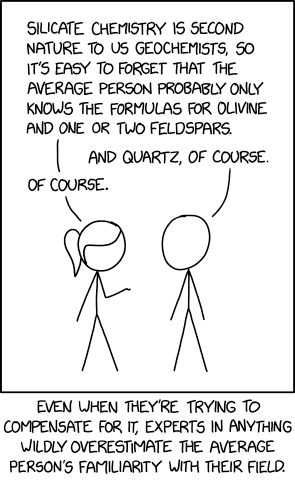
Subject matter experts often suffer from the ‘curse of knowledge’.
They care about communicating their knowledge in a clear and accessible way; but this is genuinely difficult, and it becomes more, not less, challenging the more experienced they are. The longer they have been an expert in a field, the more they have learned, the harder it is for them to perceive when:
they are leaving out crucial context,
they are using unfamiliar jargon (or worse, that they and their audience are using the same jargon to mean different things),
they are assuming prerequisite knowledge that their audience doesn’t have,
they are assuming that their audience has the same core goals as they themselves have.
The standard solution is to tell the audience to ‘ask questions if you don’t understand’.
But this rarely solves the problem. Often, the audience can’t articulate the question - they don’t know what they don’t know. Also, unfortunately, admitting ignorance can have real or perceived social costs. Saying “I don’t know what you mean by that” requires a degree of confidence and security in one’s position which not all stakeholders will have.
This issue can impact not only formal staff training programmes, but also, e.g.:
Onboarding experiences
Cross-functional communications
Internal documentation
Communications with external stakeholders
My role is to spot when this is happening, and build systems to fix it.
I analyse the gaps between what experts think they're communicating and what their audience actually understands. Then I help redesign the learning experience, the documentation, or the communication practices to actually bridge that gap.
Here are some examples of the kinds of problems I’ve identified and addressed:
A company wanted to ensure that their R&D team understood why they were asked to prioritize one line of research over another (which the R&D team saw as having greater potential). Senior management had asked the R&D team to familiarise themselves with the company strategy documents. My analysis of the documents revealed that in order to ‘join the dots’, the R&D team would need to be familiar with the distinction between ‘value creation’ and ‘value capture’; and a stakeholder interview revealed that they were not. I designed a succinct, asynchronous curriculum which introduced them to the core business concepts they would need in order to understand the documents and communicate more effectively with the business team.
A highly specialist company was hiring new staff from a neighbouring field. I investigated the culture of that field to identify any contrasts in working practices which might affect their onboarding process. I discovered that in their ‘field of origin’, building complex processes was normal and necessary: simpler processes were less reliable. However, in the company’s own field, the goal was to build processes which were as simple as possible: these were more reliable. I reported back on this, and aided in the design of onboarding materials which explicitly acknowledged this shift and helped new staff to recalibrate.
A company was using an idiosyncratic term to describe their core product’s USP. I performed an analysis of a transcript of a major industry conference, confirmed suspicions that the idiosyncratic term was not used, and identified alternative terms with similar meanings which were in more common use at the conference. I then advised on a strategic choice: either use familiar terms that investors already understood (sacrificing some precision), or use their precise but unfamiliar term (risking confusion). I recommended using familiar terms for initial conversations, and then introducing precision later, once an initial understanding and engagement had been achieved.
To learn more about my tools and approaches, take a look at my Essays.
Get in touch
If you read through the problems above with a spark of recognition, then please get in touch via the form below. I’d be delighted to talk about how my approach could benefit your organisation. I offer a free, no-obligation introductory Zoom call.
“Imagine thinking out loud about something important to you and having someone well versed in philosophy gently push you when you are stuck and tell you about what other people, smart people, have thought around the issue you're dealing with. How invaluable is that?!”
- Andrés Velasquez
(Private Client)